Showing posts with label Consumer Culture. Show all posts

02 December 2007

Enjoy the Silence? Please?

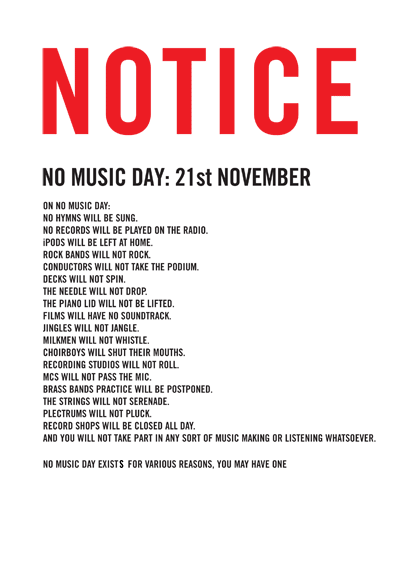
I'm really late getting to this Salon post, but I've been out of town and I'm just now getting caught up on my blog reading. Having a cold allows you to catch up on your reading. The article came at a very appropriate time of year: the holiday season. The article is about a movement in Britain, called No Music Day. As the graphic will show you, for one day no music is played, and we forget how pervasive background music has become in our everyday lives.

I am a music lover. I've played piano, cello, violin. I've been a classical ballet dancer, which requires a certain musical ear and appreciation. I love all types of music, and can even appreciate the art in tunes I don't particularly like. I am a music lover. But at this time of year the music that fills out everyday lives starts to make me a little stabby.

I used to love Christmas music, even though I'm not a religious person. To me, they used to symbolize an exciting time of year filled with friends, family, homecomings, good food, and gift-giving. The first time I'd hear a holiday tune in a store or on the radio, my heart jumped a bit at the anticipation of the holidays, that it was finally here. Then one Christmas after college I worked part time in retail to make some extra money. And I now have a strong aversion to holiday music. Working eight hour days listening to the same hour-long loop of Christmas music started making me a bit delirious. At night, while trying to fall asleep, I couldn't get the music out of my head. As I approached the shop for my shifts, I could hear the music wafting out of the front doors, and I would fill with dread.

Now, everywhere I go, I hear that dreadful noise, and it just puts me in a bad mood. I realize that this is a personal issue, but I've also noticed that just about everyone I know feels the same. Christmas music is no longer special or exciting, it's almost a hassle you must put up with for the last two (3? 4? Do I hear 6?) months of the year. I guess I'm just a scrooge. But this is something that needs to be examined more closely. In the name of consumerism, we have cheapened one of humanity's greatest artforms: music.

08 November 2007

Lifestyles of the Rich and Pathetic

Via Jessica, this New York Times story was not fit to read over lunch, but I did anyway. Big mistake. *burp*

Summary: Really wealthy people with powerful careers hire a woman to plan their lifestyles. Clothes, social activities, living quarters, even friends. All of her clients are men, she's had only one female client, and it sounds like she only got help finding a place to live. Quite honestly, getting help finding a place to live is not such a bad idea, especially if you're new in town. And double especially if it's New York City, but I digress.
Most of Ms. Storr’s clients are single and too preoccupied with work to organize their personal lives, she says.
Isn't your personal life a pretty important part of the rest of your life? Aren't you missing out on a lot when you have someone else plan it for you? Are these people just so socially inept that they can't deal with social stuff and have to hire someone to make it a little easier?

Not really. Money quote:
He calls her an outsourced wife. “The nice thing is that when I ask her to do something, she gets it done and there’s no negative feelings."
Barf.

In other words, he'd love to be able to boss around his wife, but that uppity bitch gets in his face, so now he pays someone to let him boss her around. Got it. I once dated a guy who used to bitch about all the things he had to do for himself (pick up drycleaning, grocery shopping, post office, regular daily stuff) and say that he needed a wife. When I corrected him and told him that what he really wanted was a personal assistant, he came right back and said he'd rather have a wife. Because they're basically free, and you can fuck them after a long day of bossing them around. I dumped him a few days later. I can't believe it took me so long.

At the end of the piece, we see that one of her clients is still lost:
Mr. Peik looked pleased but slightly out of his element, as if observing a diorama of his New York life and trying to figure out where he fit in. “It’s been a really fun night,” he said. “It didn’t feel forced and didn’t seem like we were the reason for Allison having a party.”
Really? Did he say that with a straight face? Here comes my chicken salad on rye . . .

10 July 2007

Planned Obsolescence

I haven't written much lately because my home computer has been acting up. It finally died this weekend, prompting me to take it to a repairperson. They person informed me that my 4 year old laptop could not be repaired because there are no longer any parts available for that model. A 4 year old computer. As a side note, I was telling someone just 2 weeks ago how great it was that my computer was still running very well at its "advanced" age. Irony is a bitch.

After scrambling my money around and purchasing a groovy new MacBook Pro, I was talking to my mother about my computer dyying. "Isn't that a new computer?" she asked. "Not really, it's 4 years old." "That sounds new to me." "You don't know a lot about computers, then." And on and on. But I got what she was really saying.

Things don't last anymore. TVs, computers, cellphones, coffee makers, major appliances, anything plastic, bras, shoes. Buying a quality item means that it will last for ten years instead of five, if you're lucky. This is planned obsolescence in action. Basically, manufacturers create goods that will last (or be supported) for a limited amount of time, after which the consumer is compelled to buy a new one. You never see TV repair shops around because the manufacturers don't want you to get your 15 year old set repaired. They want you to replace it with a newer model, which is supposedly better than your old one. The problem is that the newer model, which more technologically advanced, has more opportunities to malfunction, and warranties are only 1 year usually.

Not only is this frustrating for consumers like myself, who must have a home computer in order to fulfill my professional and academic responsibilities, but it is also bad for the environment. Think of all of the TVs, cellphones and dishwashers hanging out in landfills everywhere. Think of the toxicity running off into the water supply of the local town, which is usually an impoverished one without the political capital to fight against it.

I also think that, since Americans are raised to become good* consumers, we are conditioned to always want the newest and the best, even if our current product works fine. I have friends who buy new cellphones when a new one comes out, even though the one they have works just fine and still has a lot of the cool technological features. They just want to have the latest cellphone. Even I, in my purchase of my new laptop, was enamored with all the bells and whistles of the model I finally purchased. Although, it would have been nice if my old laptop could have held out for a couple more years.

Advertising plays the biggest part in this. I've often thought that advertisers are some of the smartest people in the world, if only because they know how to manipulate huge numbers of minds at once with just 30 second spots on TV. And they have done it, especially with new technology.

* Meaning, the more money spent the better, not necessarily responsible consumption.